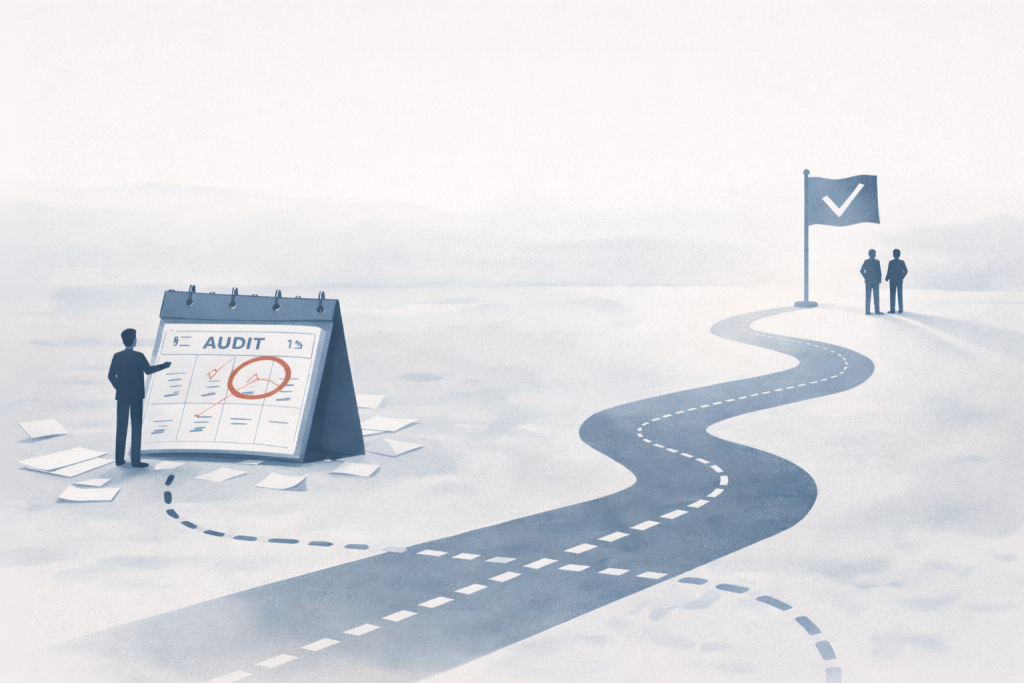
Audit Readiness Is a State, Not a Project
Introduction: The Familiar Rush
It usually begins the same way.
An email arrives.
An audit is scheduled.
A date appears on the calendar.
Suddenly, everything changes.
Documents are refreshed.
Folders are cleaned up.
Processes that have been “almost ready” for months are finalized in days.
People start working late—not to improve controls, but to make them look complete.
For a few intense weeks, the organization becomes hyper-compliant.
And when the audit ends—successfully—the pressure disappears.
Until the next one.
This cycle feels normal in many IT organizations. It shouldn’t.
Because audit readiness was never meant to be a project.
The Problem With Treating Audit Readiness as an Event
When audit readiness is treated as something you prepare for, it changes behavior in subtle but damaging ways.
Work becomes reactive.
Controls are reinforced temporarily.
Evidence is created to survive inspection—not to support operations.
Teams learn an unspoken lesson:
What matters most is how things look during the audit window.
Outside that window, reality slowly drifts.
This creates a false sense of security.
Passing the audit feels like success—but it often says more about preparation than about control.
Why Audits Don’t Measure What We Think They Measure
Audits are designed to do one thing well: assess compliance against defined criteria at a point in time.
They are not designed to:
- test operational resilience,
- uncover every weakness,
- or predict how systems behave under stress.
Auditors sample.
They ask structured questions.
They review what can be shown.
That doesn’t make audits ineffective—but it does make them limited.
When organizations confuse “audit success” with “being under control,” they stop paying attention to what happens between audits. That’s where most failures occur.
The Cost of Audit-Driven Behavior
Over time, audit-centric thinking creates predictable patterns:
- Evidence becomes more important than execution
- Processes exist primarily in documentation
- Risks that don’t threaten audit outcomes stay invisible
- People hesitate to report weaknesses close to inspections
In the worst cases, teams start fixing problems after audits, not before—because acknowledging them earlier might create findings. Compliance turns into choreography. And governance quietly loses its purpose.
What Audit Readiness Actually Means
True audit readiness is not about speed. It’s about stability.
It means:
- Controls operate the same way in April as they do in October
- Evidence is generated naturally through daily work
- Documentation reflects reality—not aspiration
- Risks are visible even when no auditor is watching
In this state, audits stop being disruptive.
They become confirmatory.
The organization doesn’t switch modes.
It simply continues to operate.
How Organizations Move Toward a “Ready” State
Organizations that escape audit panic rarely do it by adding more controls.
They do it by changing how controls live in the organization.
They focus on:
- Designing controls into workflows, not around them
- Reducing manual evidence creation
- Clarifying ownership, so controls don’t depend on individuals
- Talking about risk continuously, not seasonally
Most importantly, they stop treating audits as deadlines—and start treating them as feedback.
The Role of Leadership in Audit Readiness
Audit readiness is not something IT teams can sustain alone.
Leaders set the tone when they:
- ask about control health outside audit season,
- reward transparency instead of silence,
- accept short-term discomfort to avoid long-term fragility.
When leadership only asks, “Will this pass the audit?”, teams optimize accordingly.
When leadership asks, “Does this work reliably?”, governance starts to mature.
A Simple Reality Check
Ask yourself:
- Would our controls still work if the audit were canceled tomorrow?
- Do we know where our evidence comes from—or do we just collect it?
- Are issues raised early—or delayed until after inspections?
- Do people trust the system—or just the documents?
If audit readiness disappears when the calendar reminder does, it was never readiness.
It was preparation.
Conclusion: From Panic to Confidence
Audits will always matter.
Regulatory expectations won’t disappear.
But organizations that rely on last-minute readiness live in constant tension—always compliant, never confident.
Audit readiness is not something you reach.
It’s something you maintain.
When readiness becomes a state:
- audits lose their power to disrupt,
- governance becomes practical,
- and compliance stops being a performance.
The strongest organizations don’t prepare for audits.
They operate in a way that audits simply confirm.