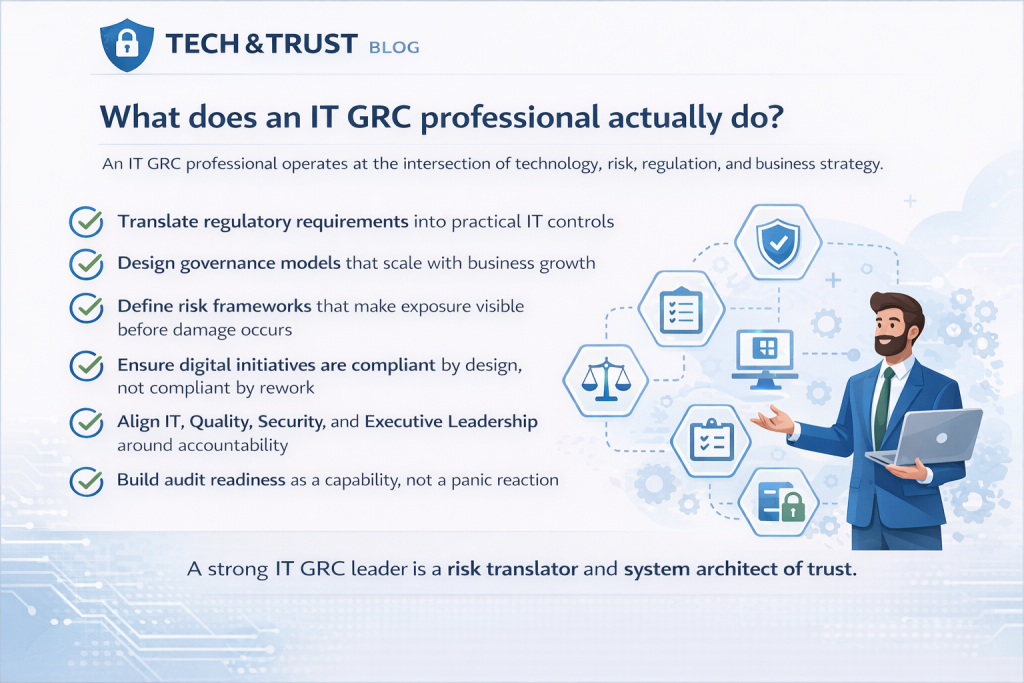
What Does an IT GRC Professional Actually Do?
The role of an IT Governance, Risk, and Compliance professional is often misunderstood because much of its value becomes visible only when it is missing. When systems fail audits, when risks materialize unexpectedly, or when delivery teams are forced into late rework due to overlooked regulatory requirements, the absence of structured governance becomes obvious. When everything runs smoothly, however, the work behind that stability is rarely noticed.
At its core, an IT GRC professional operates at the intersection of technology, risk exposure, regulatory expectation, and business strategy. The function is not limited to writing policies or preparing audit documentation. Those are outputs. The real responsibility lies in designing and maintaining the structural integrity of the digital environment in which the organization operates.
This requires translating external regulatory requirements into internal control mechanisms that are technically feasible and operationally sustainable. Regulations rarely describe how to implement controls in modern architectures, cloud platforms, or automated pipelines. Someone must interpret intent, assess risk relevance, and convert abstract requirements into practical design decisions. That interpretative responsibility is central to the role.
An effective IT GRC professional also ensures that risk is made visible before it becomes damage. This involves establishing structured risk assessments, maintaining a dynamic risk register, defining control frameworks, and continuously reassessing whether controls remain proportionate to evolving threats and business growth. Governance, in this sense, is not static documentation but an adaptive system of risk-informed decision-making.
Another essential responsibility is embedding compliance into delivery processes rather than attaching it afterward. When governance enters too late in a project lifecycle, it creates friction and rework. When it is integrated early, it becomes part of the solution architecture. The difference is not procedural but structural. Compliance by design reduces both regulatory exposure and operational inefficiency.
The role also demands alignment across functions. IT, Security, Quality, Internal Control, and Executive leadership must operate with a shared understanding of accountability. Ambiguity in responsibility is a frequent source of both compliance gaps and organizational tension. A mature GRC professional clarifies ownership without absorbing execution responsibilities that belong elsewhere. Independence and collaboration must coexist.
Perhaps most importantly, IT GRC builds audit readiness as a capability rather than as a periodic emergency response. This means establishing traceability, documentation standards, monitoring mechanisms, and reporting structures that function continuously. Audit readiness, when designed properly, is simply a by-product of disciplined operations.
In an era defined by accelerated cloud adoption, artificial intelligence, cybersecurity volatility, and increasing regulatory scrutiny, the complexity of digital ecosystems continues to expand. Organizations do not merely need compliance oversight; they need governance architecture. The IT GRC professional serves as a translator of risk and an architect of trust, ensuring that technological progress remains sustainable, defensible, and aligned with strategic objectives.
When executed well, the role does not slow innovation. It enables controlled acceleration. It provides the structural clarity that allows organizations to grow without compromising resilience. That is the real contribution of IT GRC: not control for its own sake, but the disciplined design of digital trust.